

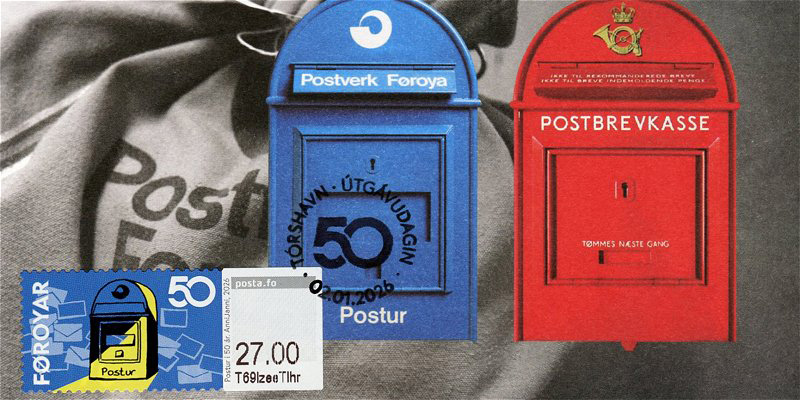
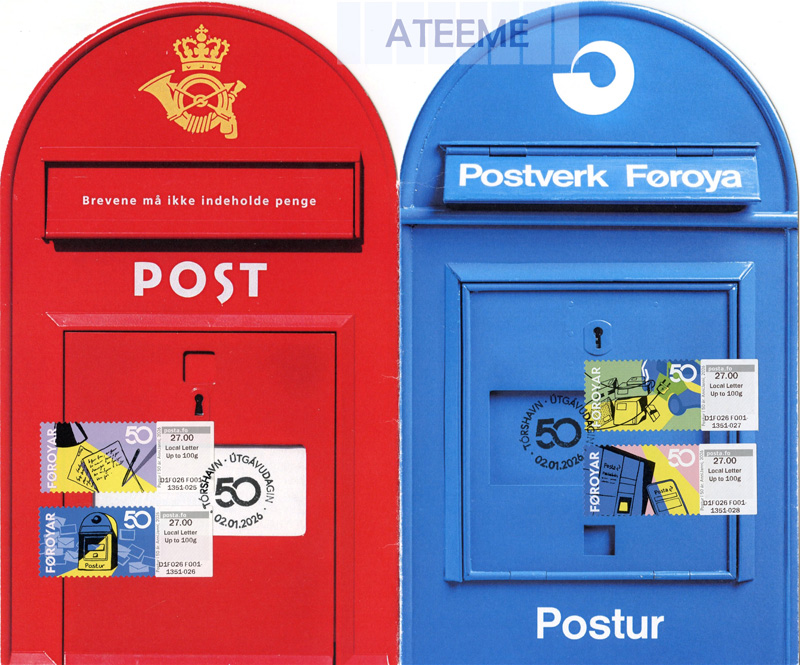
The first post office in the Faroe Islands opened in the capital, Tórshavn, on March 1st 1870. The postal service in the archipelago was run by Post Danmark, the Danish postal service, until April 1st 1976, when the Faroe Islands’ autonomous government took over the service by establishing its own postal service, known as Postverk Føroya. The first series of stamps bearing the caption ‘FØROYAR’ was issued in late January 1975, and the old red Danish post boxes were gradually replaced by blue ones featuring the new logo (see images at the beginning and end of the article).
In 2005, the company ceased to be publicly owned and became a limited company, with a network of just over 30 post offices and around 300 employees, serving a population of some 50,000.
In August 2009, Postverk Føroya adopted a new corporate identity and the name Posta.
Fifty years on the company Posta has 120 employees and provides services to the 56,000 inhabitants of the Faroe Islands through a combined network of 17 post offices, as well as partner shops and parcel lockers stations.
As far as our field of study is concerned, the then Postverk Føroya began installing postal kiosks and desktop printers from the Danish company aCon and releasing – at least one – annual series of labels for variable value stamps starting in 2008 (see article, published in VARIABLE 11). Posta Stamps, the Faroe Islands’ philatelic service, began using a DKU desktop kiosk from the IAR company in 2017 (see article and VARIABLE 47).
Between 2008 and 2025, Posta Stamps had issued twenty series of four designs for variable value stamps, all of which were featured in articles on our previous website and in the VARIABLE publications up to the end of 2022, and from 2023 onwards on this website.
In 2026, Posta Stamps naturally wished to mark this important milestone with the issue of several special philatelic events coinciding with the April 1st anniversary, and a new series of ATMs or variable value stamps, which have been available since the beginning of the year.
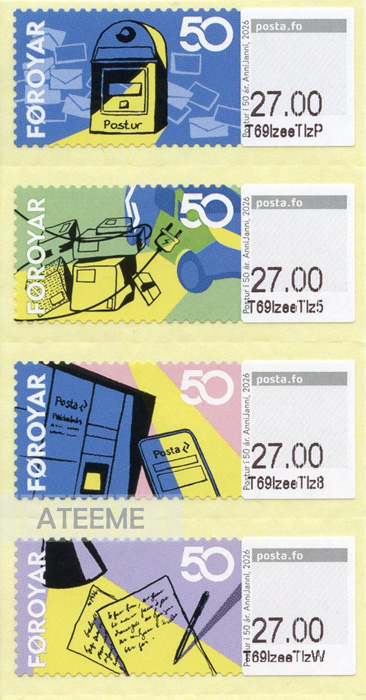
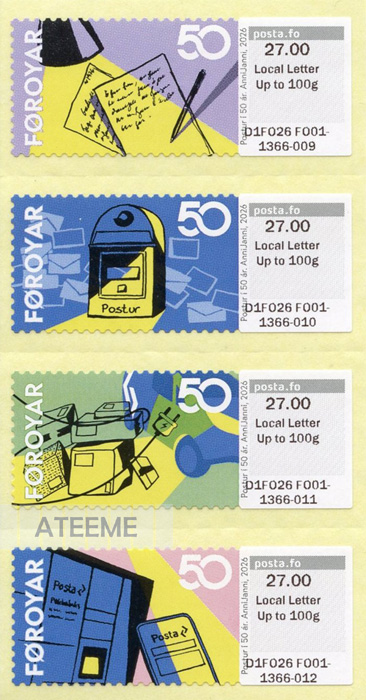
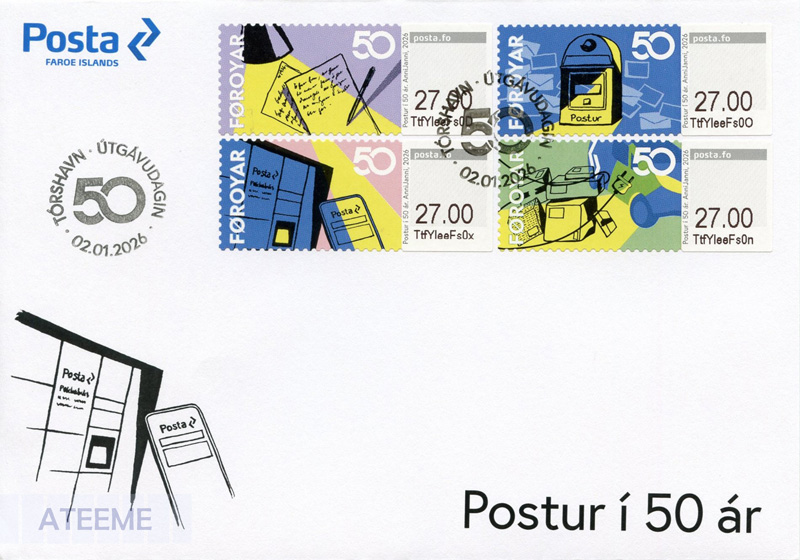
The four designs in the new series are by the local design studio AnniJanni (Anni Arge Lamhauge & Janni Johansen) and depict the evolution of the Faroese postal service over the past fifty years; an era which has included personal mail and handwritten letters, letterboxes overflowing with letters, the rise of parcels delivered by electric vans, and the digital present with tracking apps and convenient parcel stations.
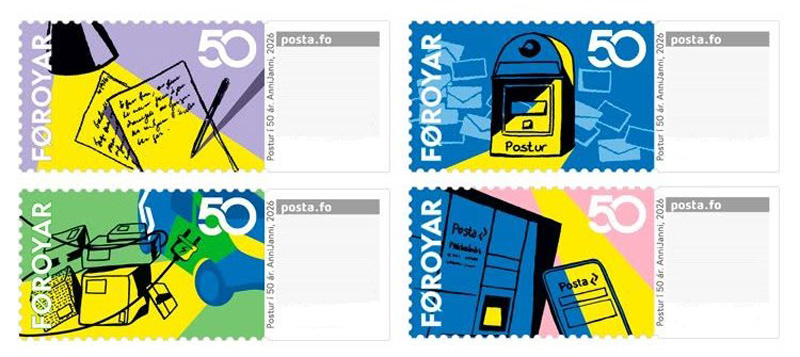
The rolls of thermal self-adhesive labels, with the four consecutive designs, were printed by flexography and manufactured by the Danish company All4Labels.
The ‘Postur í 50 ár‘ series was available from January 2nd 2026 and as with the previous years’ series, was printed on two different equipments, the aCon desktop printers and the IAR’s DKU (Desktop Kiosk Unit), installed at the premises of the philatelic service.
The small aCon thermal printers only print the face value and an 11-digit code at the bottom of the stamp. Customers can purchase stamps with any value from 0.50 to 99.50 kr.
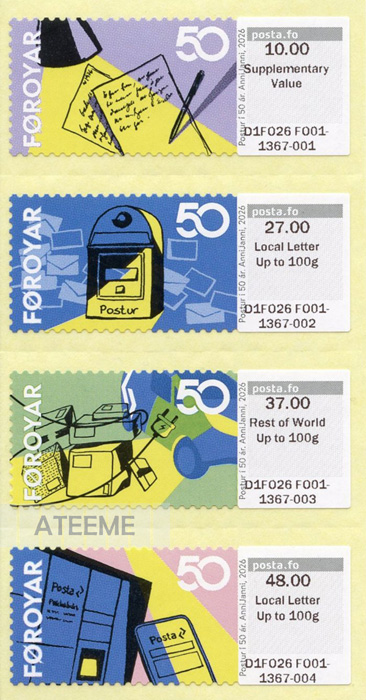
The stamps printed by the DKU unit include the face value, the type of shipment indicator, and a code consisting of four data blocks. The stamps illustrated below, printed in January 2026, show the code with the first block as D1FO26 (D for the DKU equipment, followed by the month (1), country (FO) and year of issue). There then follows the equipment code (FO01), the session and stamp number.
This kiosk prints variable value stamps with four programmed values only, which vary each year with the change in postal tariffs (see table below). The 2026 programmed set is made up of the values of ‘10.00 Supplementary up to 100g‘, a “make up” value that recurs year after year and does not correspond to any existing postage rate; ‘25.00 Local Letter Up to 100g‘, the first domestic postage rate; ‘35.00 Rest of World Up to 100g‘, the first value for international mail; and ‘48.00 Local Letter Up to 100g‘, the domestic mail rate for large letters or small parcels.
aCon desktop printers
DKU – IAR unit
‘Local Strip’
DKU – IAR unit
Set or ‘Collectors Strip’
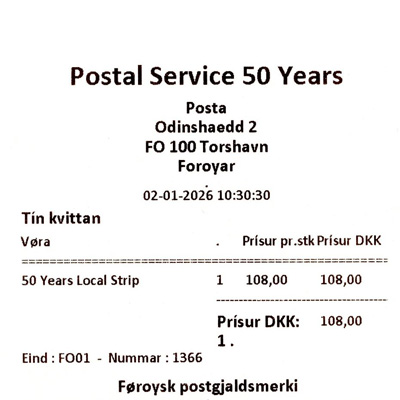
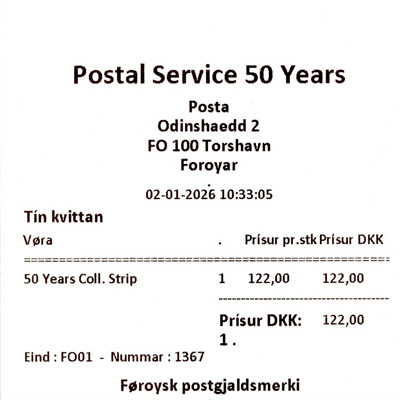
After each transaction the DKU unit issues receipts printed on thermal paper. ‘Local Strip’ is the strip of four stamps with the first domestic postage rate. ‘Coll. Strip’ is the set with the four programmed values. ‘Coll. Set’ is the full set of 16 values that includes the four postage values with the four designs.
Official first day cover with the four designs, issued by an aCon desktop printer, with the special postmark.
(English edition rewritten by J. Gareze – August 2026)
Access to this site, and to the website in general, is monitored and its contents are protected by copyright.
The unauthorized copy of the text and / or images is prohibited